← Back to Mike's Thoughts
Mike Smith
July 27, 2026

Welcome to Teaching Sustainability, the 20-week series from Aclymate created to help small and mid-sized business leaders understand what sustainability means, why it matters, and what to do next. Each week, we cover one practical topic — from carbon accounting and reporting to certifications and climate action — in clear, simple language designed to help you build a more resilient, credible, and competitive business.
Last chapter, we looked at Scope 1 and Scope 2 — the emissions inside your operational walls and on your utility bills. Those two buckets tend to be manageable: the data is close at hand, and the levers for change are directly yours to pull. This chapter is about the bucket that usually isn't either of those things: Scope 3.
What's Actually Inside Scope 3
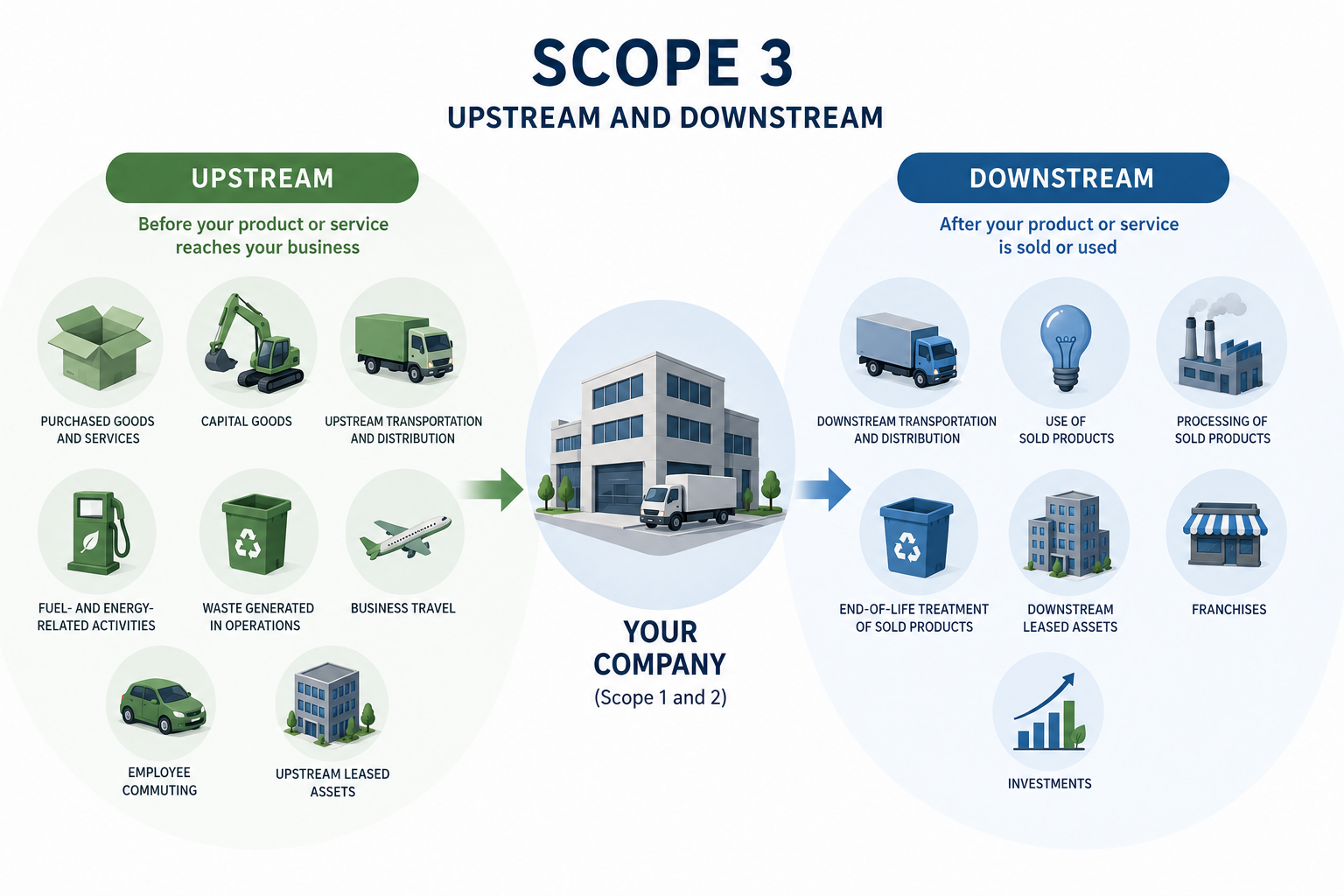
The GHG Protocol organizes Scope 3 into fifteen categories, which can feel overwhelming until you group them into two simpler ideas: upstream and downstream.
Upstream covers everything that happens before your product or service reaches a customer — the goods and materials you purchase, the equipment you invest in, transportation of those goods to you, waste generated in your operations, employee business travel and commuting, and emissions embedded in leased assets you use but don't own.
Downstream covers everything that happens after you've sold something — how your products are shipped to customers, how they're used once they're in someone else's hands, and what happens to them at the end of their life.
Not every category applies to every business. A software company has little to say about "processing of sold products." A furniture manufacturer almost certainly does. Part of the work in Scope 3 is figuring out which categories are actually relevant to you — the GHG Protocol's relevance principle applies directly here.
Why Scope 3 Is Usually the Biggest Bucket
We mentioned this in an earlier chapter, but it bears repeating here: for most companies, Scope 3 represents 70 to 90 percent of total emissions. That's not a coincidence — it reflects the fact that Scope 1 and 2 only capture what happens inside your own operations, while Scope 3 captures the entire footprint of everything your business touches, from raw materials to end use. A company can run a lean, efficient facility and still have a Scope 3 footprint many times larger than its Scope 1 and 2 combined, simply because of what it buys and sells.
Why It's Also the Hardest
The same thing that makes Scope 3 large also makes it difficult: most of the relevant data doesn't live inside your business. It sits with your suppliers, your logistics providers, and your customers — parties you can influence but don't control. Precise, activity-based data (exact fuel used to ship your goods, exact energy consumed by your product in use) is rarely available at the outset, which is why spend-based estimation — a method we'll cover in detail next chapter — plays such a large role here. It's also, frankly, why many companies avoid Scope 3 altogether. The scale and uncertainty can feel paralyzing.
Why It's Worth Doing Anyway
Avoiding Scope 3 means avoiding the majority of your actual footprint — and increasingly, avoiding it isn't an option. Large customers are asking suppliers to report supply chain emissions as part of vendor requirements. Investors and certification bodies expect a complete inventory, not just the convenient parts. And regulation is moving in this direction as well — frameworks like the EU's Corporate Sustainability Reporting Directive and California's SB 253 extend disclosure expectations into the value chain, which means Scope 3 pressure is likely to keep growing, not shrink. There's also a more constructive reason: because Scope 3 is so large, it's often where the biggest reduction opportunities live, even if they require working with partners rather than acting alone.
Where to Start: Prioritize, Don't Boil the Ocean
You do not need precise data across all fifteen categories to make meaningful progress. The practical approach is a hotspot analysis: identify the two or three categories most likely to dominate your footprint given your business model, and focus your early effort there. A retailer's biggest Scope 3 category is usually purchased goods. A logistics company's is usually transportation and distribution. A professional services firm's is often business travel and employee commuting. Start with a spend-based estimate across all relevant categories to get full coverage, then invest in more precise, supplier-specific data for whichever category turns out to matter most.
What to Do This Week
How Aclymate Helps
Aclymate builds a full Scope 3 estimate using spend-based methodology from day one, so you get complete category coverage without waiting on supplier data that may take months or years to gather. As better information becomes available — from suppliers, logistics partners, or your own operational records — the platform lets you swap in more precise, activity-based figures category by category. On the Aclymate One tier, your Carbon Bookkeeper helps you identify which categories are worth that additional effort first, based on where your actual hotspots are.
The Takeaway
Scope 3 is big, it's outside your direct control, and it's genuinely harder than Scope 1 and 2. It's also, for most businesses, where the real story of their footprint lives. The goal isn't precision everywhere on day one — it's credible, complete coverage that you refine over time, starting with the categories that matter most.
Next chapter, we'll dig into the methodology question that makes Scope 3 possible in the first place: activity data versus spend data, and when each one is the right tool for the job.
Get Aclymate's practical sustainability content delivered weekly.

If your company is considering SBTi validation, understand the people, data, cost, timeline, and ongoing obligations before you begin.
Read Article

Your company may never be required to join SBTi. But if your customers have science-based targets, their commitments can create very real expectations for you.
Read Article

Most small and mid-sized businesses know they should be doing something about sustainability. The ones that actually make progress share one thing in common: they started with a clear sequence. Here it is.
Read Article
Talk with a Sustainability Expert, see a demo, or start free to put the Aclymate platform and experts to work for your team.