← Back to Mike's Thoughts
Mike Smith
October 19, 2026

Welcome to Teaching Sustainability, the 20-week series from Aclymate created to help small and mid-sized business leaders understand what sustainability means, why it matters, and what to do next. Each week, we cover one practical topic, from carbon accounting and reporting to certifications and climate action, in clear, simple language designed to help you build a more resilient, credible, and competitive business.
Last chapter, we covered what businesses need to understand before committing to SBTi, and why preparation matters as much as ambition when it comes to credible climate commitments. This chapter steps back from any single framework or requirement and asks a broader question: across everything this series has covered, where does your business actually stand? And what does the path forward look like from here?
A sustainability maturity model is a diagnostic tool. It maps the stages that businesses typically move through as they build more sophisticated, credible, and impactful sustainability programs, from the earliest steps of awareness and basic measurement through to the kind of integrated, verified, and strategically embedded programs that the most advanced businesses operate. Knowing where you sit on that spectrum is the prerequisite for knowing what to do next.
One of the most common traps in sustainability is activity without direction. A business attends a sustainability workshop, subscribes to an offset program, adds a "we care about the environment" line to its website, and feels like it is making progress. Another business spends months building a detailed carbon inventory, sets internal reduction targets, and begins engaging suppliers, but never communicates any of it externally and never seeks third-party verification. Both businesses are doing something. Neither has a clear picture of how their efforts compare to what sophisticated customers, investors, and certification bodies actually expect.
A sustainability maturity model solves that problem by defining what each stage of development actually looks like in concrete, observable terms. It is not a judgment. It is a map. And like any map, its value is in helping you understand both where you are and what the terrain ahead looks like.
The model below reflects the progression we have traced throughout this series, from the foundational work of measurement through to the advanced integration of sustainability into business strategy and supply chain management. Most small and mid-sized businesses will find themselves somewhere in the middle stages. That is exactly where the work matters most.
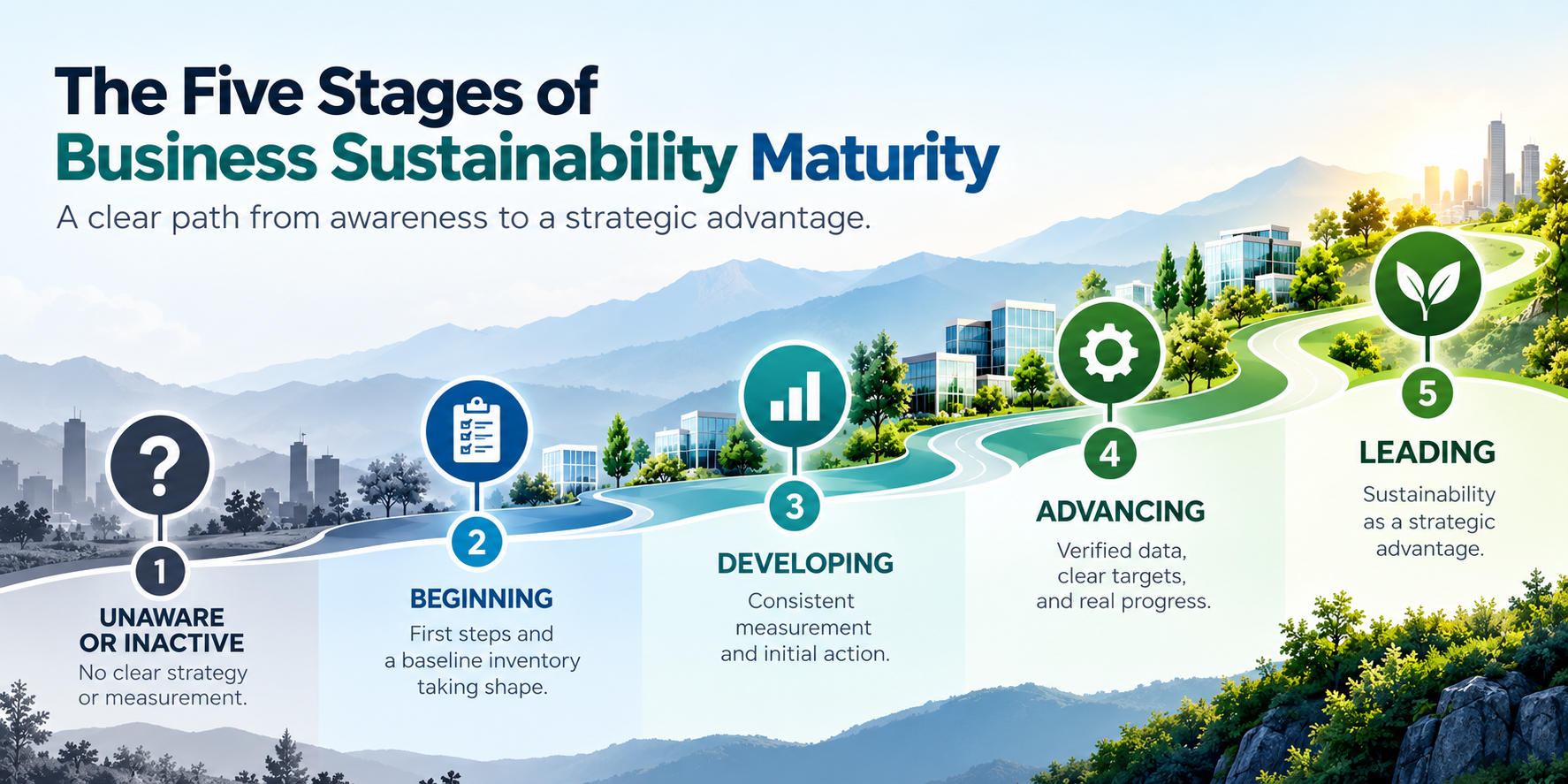
At this stage, the business has not yet engaged meaningfully with sustainability as a business practice. There may be general awareness that sustainability matters, but no systematic effort to measure emissions, no formal environmental policies, no certifications, and no external reporting. Sustainability, if it appears anywhere, is limited to informal gestures such as recycling programs or energy-saving reminders, without any connection to a broader strategy or measurable outcomes.
This is not a comfortable place to be in 2026. Customer questionnaires are arriving. RFPs are including sustainability sections. Large enterprise customers are beginning to ask supplier questions that require more than a good-faith response. A business at Stage One is increasingly exposed to commercial risk, even if no individual regulation directly applies to it.
The priority at this stage is not to solve everything at once. It is to begin measurement. Getting a baseline emissions inventory in place, even an imperfect one built primarily on spend-based estimates, transforms the situation from one of complete opacity to one with a starting point. Everything else follows from that.
At Stage Two, the business has taken its first real steps. There is a baseline emissions inventory, or one is actively in progress. The business understands its Scope 1 and 2 emissions and has at least a partial picture of Scope 3. It may have started responding to supplier sustainability questionnaires, though perhaps inconsistently. There may be an initial environmental policy document. Sustainability is on someone's agenda, even if it is not yet a dedicated function.
The characteristic challenge at Stage Two is fragmentation. Emissions data may exist in a spreadsheet that nobody owns consistently. Questionnaire responses may be handled reactively, with different people providing different answers each time. There is activity, but no system behind it, and progress is hard to demonstrate because it has not been defined against a baseline or tracked consistently over time.
The priority at this stage is to build the infrastructure: a consistent, repeatable measurement process; a defined organizational boundary; documented methodology; and a single owner for sustainability data. The goal is to move from a one-time calculation to an annual process. That transition, from event to program, is the most important step a Stage Two business can take.
At Stage Three, the business has a functioning emissions inventory updated at least annually, documented methodology, and a baseline year against which progress is measured. It is responding to supplier questionnaires consistently and may have achieved an initial certification. Leadership is aware of the sustainability program and considers it a business priority, even if it is not yet embedded in operational decision-making.
Reduction efforts may have begun, typically starting with the most accessible levers: energy efficiency, renewable electricity procurement, or travel reduction. Targets may exist, though they are often self-set rather than third-party validated, and the reduction roadmap may be more aspirational than operational. External communication is happening, though it may still rely on general language rather than specific, data-backed claims.
The characteristic challenge at Stage Three is credibility. The business is doing real work, but the work is not yet independently verified, the targets are not yet science-based, and the Scope 3 inventory may still rely heavily on spend-based estimates for categories that represent significant emissions. Sophisticated customers and certification bodies will push on exactly these gaps.
The priority at this stage is verification and depth. Pursue third-party certification. Upgrade spend-based Scope 3 estimates to activity-based data in your highest-emission categories. Begin the process of developing science-based targets through SBTi's SME pathway. Tighten external communications so every public claim is specific, scoped, and substantiated.
At Stage Four, the business has a verified, complete emissions inventory across all three scopes, updated annually with consistent methodology. It holds at least one meaningful third-party certification, responds confidently and accurately to EcoVadis, CDP, and customer questionnaire requests, and has set near-term reduction targets that are either SBTi-validated or in the process of validation. Reduction initiatives are operational, with owners, timelines, and measurable milestones, and the business can demonstrate year-over-year progress against its baseline.
Sustainability is embedded in business operations, not siloed in a function. Procurement decisions consider supplier emissions data. Capital investments are evaluated with their emissions impact as a factor. Leadership reviews sustainability metrics alongside financial metrics in regular business reviews.
The characteristic challenge at Stage Four is scaling impact beyond the business's own operations. Scope 1 and 2 emissions may be well-managed and on a credible reduction trajectory, but Scope 3, particularly purchased goods and supply chain emissions, remains complex, data-sparse, and difficult to influence directly. The business understands its supply chain footprint in broad terms but may lack the supplier-level data to drive meaningful reductions in its largest Scope 3 categories.
The priority at this stage is supply chain engagement and long-term target development. Begin active supplier engagement in your highest-emission Scope 3 categories, requesting emissions data, understanding supplier reduction trajectories, and, over time, incorporating sustainability performance into supplier selection and contract terms. Develop long-term net zero targets aligned with SBTi's Corporate Net-Zero Standard. Invest in the data quality and verification rigor that institutional investors and large enterprise customers increasingly expect.
At Stage Five, sustainability is a strategic business asset, not a compliance program. The business has SBTi-validated near-term and long-term targets, a verified complete inventory updated annually, active supplier engagement programs that are generating measurable Scope 3 reductions, and a public sustainability report that meets the standards expected by CDP, GRI, or equivalent frameworks. Certifications are maintained and built upon. The business's sustainability program is a source of competitive differentiation, customer retention, and talent attraction.
Sustainability decisions are integrated into strategy at the board level. The CFO models the financial implications of carbon pricing and climate risk. The product development team designs with end-of-life emissions in mind. The procurement function scores suppliers on sustainability performance as a standard part of vendor assessment.
Few small and mid-sized businesses are at Stage Five today. But the direction of travel across every commercial, regulatory, and competitive force in the market points toward Stage Five being the expected standard for serious businesses within the next decade. The businesses building toward it now are the ones that will find that transition manageable rather than disruptive.
Across the businesses that engage with sustainability programs and tools, the majority of small and mid-sized companies fall into Stages Two and Three. They have done some measurement, are responding to some external requests, and may have taken initial reduction steps. But the infrastructure is not yet consistent, the methodology is not always documented, Scope 3 coverage is often incomplete, and external claims are frequently broader than what the underlying data can support.
This is not a criticism. It is a description of where the journey typically is at the three to five year mark of a sustainability program for a business without a dedicated sustainability team. The gap between Stage Two and Stage Four is closed not by a single heroic effort but by building the right infrastructure, investing in it consistently, and advancing one stage at a time.
The most common barrier is not ambition. It is the absence of a clear picture of where the business currently stands and what the specific next step is. That is exactly the problem a maturity model is designed to solve.
Aclymate is built to support businesses at every stage of the sustainability maturity model, with the tools and expert support calibrated to what each stage actually requires. For businesses at Stage One or Two, the carbon accounting platform provides the measurement infrastructure, consistent methodology, and annual reporting workflow that transforms a one-time calculation into a functioning program. For businesses at Stage Three, the platform's certification support, Scope 3 coverage tools, and supplier data management capabilities address the credibility gaps that characterize that stage. For businesses at Stage Four, the reduction planning tools, SBTi preparation support, and customer-ready reporting outputs support the deeper operational integration and supply chain engagement that advancing to Stage Five requires.
On Aclymate One, your Carbon Bookkeeper and Sustainability Consultant conduct a structured assessment of your current program against the maturity framework, identify the specific gaps that are holding you at your current stage, and develop a prioritized roadmap for advancing to the next one. That combination of honest assessment and practical next steps is what turns a maturity model from a diagnostic into a plan.
A sustainability maturity model is not a grading system. It is a navigation tool. It tells you where you are, what the terrain ahead looks like, and what the specific next step is from your current position. In a space where the pressure to "do something" on sustainability is high but the guidance on what specifically to do next is often vague, that clarity is genuinely valuable.
Most small and mid-sized businesses are at Stages Two or Three. The gap between those stages and Stage Four, where the program becomes credible, verified, and commercially defensible, is not insurmountable. It is a sequence of specific, manageable steps, each one building on the last.
Know where you are. Know what the next step is. Take it. That is how a sustainability program matures from good intentions into a business asset.
Get Aclymate's practical sustainability content delivered weekly.

If your company is considering SBTi validation, understand the people, data, cost, timeline, and ongoing obligations before you begin.
Read Article

Your company may never be required to join SBTi. But if your customers have science-based targets, their commitments can create very real expectations for you.
Read Article

Most small and mid-sized businesses know they should be doing something about sustainability. The ones that actually make progress share one thing in common: they started with a clear sequence. Here it is.
Read Article
Talk with a Sustainability Expert, see a demo, or start free to put the Aclymate platform and experts to work for your team.