← Back to Mike's Thoughts
Mike Smith
November 23, 2026

Welcome to Teaching Sustainability, the ongoing educational series from Aclymate created to help small and mid-sized business leaders understand what sustainability means, why it matters, and what to do next. Each week, we cover one practical topic, from carbon accounting and reporting to certifications and climate action, in clear, simple language designed to help you build a more resilient, credible, and competitive business.
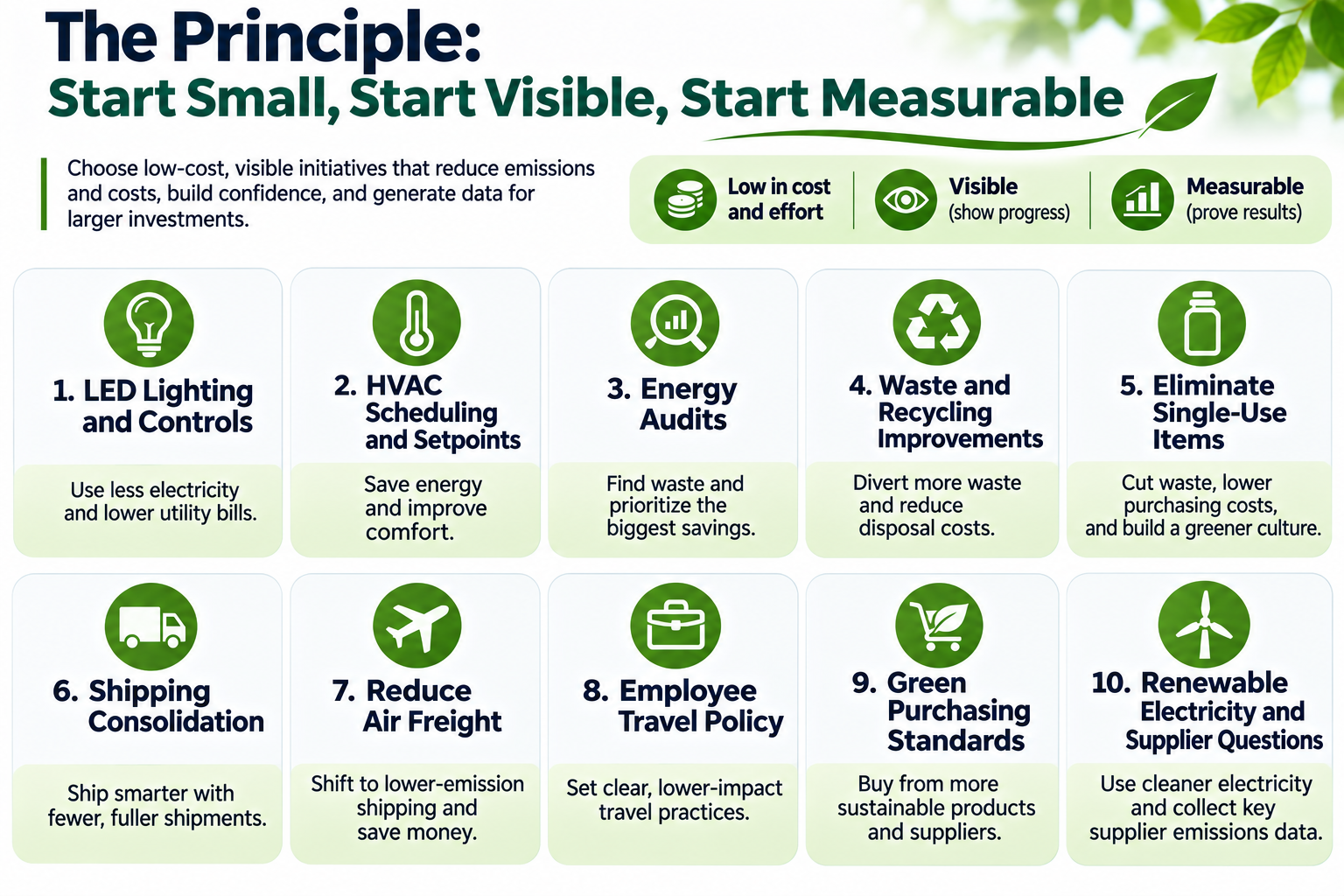
Last chapter, we covered how to build a sustainability culture employees actually participate in, and why visible, measurable wins are what keep people engaged. This chapter gives you the wins. Culture needs something to rally around, and a reduction plan needs early proof that it works. The ten initiatives below are practical, low-cost starting points that most businesses can begin within a single quarter, and that produce the kind of data your emissions inventory can actually use.
Many businesses stall on sustainability because they wait for the perfect plan. They want a complete reduction roadmap, a validated target, and a full budget before they act. Meanwhile, a quarter passes, then another, and nothing changes.
The better approach is to pair long-term planning with short-term action. Low-cost, visible initiatives do three things at once. They reduce emissions and often costs. They build organizational confidence, because people see that sustainability work produces real results. And they generate data, which strengthens your inventory and gives you a baseline for larger investments later.
Three criteria help you choose well. Pick initiatives that are low in cost and effort, so they can start without a lengthy approval process. Pick initiatives that are visible, so employees and customers can see progress. And pick initiatives that are measurable, so you can report a specific number when they are done. An initiative you cannot measure is one you cannot claim, and as we covered in the chapter on greenwashing, claims need evidence.
For each initiative below, we outline the effort, the typical cost, the environmental impact, and the business benefit, so you can compare them honestly.
Replacing older fluorescent or incandescent fixtures with LEDs, and adding occupancy sensors or timers, is one of the most reliable efficiency upgrades available.
Heating and cooling are often the largest energy loads in a building, and they frequently run on schedules that no longer match how the space is used.
An energy audit identifies where your facilities waste energy and ranks the fixes by cost and payback. It is the best way to make sure your next dollar goes to the highest-impact upgrade.
Many businesses recycle in name but not in practice, with mixed bins, contamination, and no data on what is thrown away. A basic waste review can change that quickly.
Single-use cups, cutlery, packaging, and promotional items add up quickly. Replacing them with reusable alternatives, or simply removing them, is a visible change that employees notice.
For businesses that ship products, combining orders, optimizing packaging size, and reducing partial shipments cuts both cost and emissions.
Air freight is far more emissions-intensive per unit shipped than ocean or ground transport. Shifting even a portion of shipments to lower-emission modes can make a large difference.
A clear travel policy sets expectations for when in-person travel is warranted, which modes are preferred, and how trips are approved and tracked.
A simple purchasing standard sets preferences for the products and suppliers your business buys, such as recycled content, energy-efficient equipment, or certified materials.
The final initiative has two parts that work well together.
Renewable electricity and RECs. Switching to a renewable electricity plan, or purchasing renewable energy certificates (RECs), can reduce your reported Scope 2 emissions quickly. This is one of the fastest ways to move a number, but it should be communicated precisely. As we covered in the greenwashing chapter, claiming to run on 100 percent renewable energy when you purchase RECs for a portion of your electricity is the kind of overstatement that creates risk.
Supplier questions. Add a short set of sustainability questions to your supplier onboarding or annual review: Do you measure your emissions? Do you have a reduction target? Do you hold relevant certifications? You don't need sophisticated analysis yet. The goal is to begin collecting data and signal that sustainability matters in your sourcing decisions.
You don't need to launch all ten. The right starting set depends on your business and your emissions profile.
If your hotspot analysis shows that energy is your largest source, begin with lighting, HVAC scheduling, and an energy audit. If you ship products, start with consolidation and air freight. If your footprint is dominated by purchased goods and services, begin with green purchasing standards and supplier questions. If travel is significant, the travel policy is the obvious first move.
Whichever you choose, make sure the initiative has an owner, a start date, a baseline measurement, and a date when you will report the result. A small initiative with a clear owner and a measured outcome is worth more than a large initiative that never gets finished.
Pick three initiatives that can be implemented within 90 days. Use your emissions inventory and hotspot analysis to choose those most likely to move your numbers. Favor at least one that is highly visible to employees, one that reduces cost, and one that produces clean, measurable data.
Assign an owner and a deadline to each one. One named person for each initiative, with a start date and a date by which results will be reported. If the cross-functional team from earlier in this series is in place, use it to assign ownership by function.
Capture the baseline before you start. Pull the last 12 months of the relevant data, whether that is kilowatt-hours, waste volumes, freight records, or travel miles, so that you have something to compare against. An initiative without a baseline produces an anecdote rather than a result.
Schedule a 90-day review. Put it on the calendar now. Report the measured results to the team and the wider company, and decide which initiatives to continue, expand, or replace.
Initiatives only matter if you can show what they achieved. Aclymate provides the baseline inventory and the ongoing tracking that turns each of these initiatives into a measured result. When you connect your utility, fuel, travel, and procurement data, the carbon accounting platform shows how each change affects your emissions by scope and category, so you can report that an HVAC schedule change or a travel policy reduced emissions by a specific amount rather than guessing.
The platform also helps you choose where to start, by showing which categories drive your footprint, and it tracks initiatives with owners and timelines so they stay visible. On Aclymate One, your Carbon Bookkeeper and Sustainability Consultant help you prioritize the right quick wins for your emissions profile, capture the baselines, and measure the results, so early initiatives build into a reduction program rather than remaining isolated projects.
Momentum matters in sustainability. A business that completes three small, measured initiatives in a quarter is in a far stronger position than one that spends the same quarter drafting a perfect plan. Early wins reduce emissions, save money, build employee confidence, and generate the data that every later decision depends on.
Choose initiatives that are low in cost, visible, and measurable. Assign owners, capture baselines, and report results honestly. Then use what you learn to take on the next, larger step.
Start this quarter. The best sustainability programs are built on a series of small, documented wins.
Get Aclymate's practical sustainability content delivered weekly.

Recycling bins don't create a sustainability culture. Leadership decisions, easy participation, and visible wins do. Here's how to build the kind of culture where employees contribute because they want to, not because they were told to.
Read Article

Most small and mid-sized businesses cannot hire a dedicated sustainability team. They don't need to. The expertise required to run a credible sustainability program already exists inside your organization. The work is structuring it.
Read Article

Most sustainability mission statements fail before they're published. They're written to sound good rather than to mean something. Here's how to write one that actually guides decisions, holds up to scrutiny, and reflects what your business has genuinely committed to.
Read Article
Talk with a Sustainability Expert, see a demo, or start free to put the Aclymate platform and experts to work for your team.