← Back to Teaching Sustainability
Mike Smith
August 3, 2026

Welcome to Teaching Sustainability, the 20-week series from Aclymate created to help small and mid-sized business leaders understand what sustainability means, why it matters, and what to do next. Each week, we cover one practical topic — from carbon accounting and reporting to certifications and climate action — in clear, simple language designed to help you build a more resilient, credible, and competitive business.
Last chapter, we tackled Scope 3 — the broadest and often hardest bucket to measure. One reason it's hard comes down to a methodology question that actually runs through all of carbon accounting, not just Scope 3: do you calculate emissions from activity data, or from spend data? This chapter breaks down the difference, and when each one earns its place.
A few chapters back, we covered the basic equation behind every emissions calculation: activity data multiplied by an emission factor equals CO₂e. That's the activity-based approach — using a physical quantity, like gallons of fuel or kilowatt-hours of electricity, and converting it directly. There's a second version of that equation that swaps the physical quantity for a financial one: dollars spent in a category, multiplied by an emissions intensity factor for that category, also equals CO₂e. That's the spend-based approach. Both are legitimate under the GHG Protocol. They just start from different inputs, and they come with different tradeoffs.
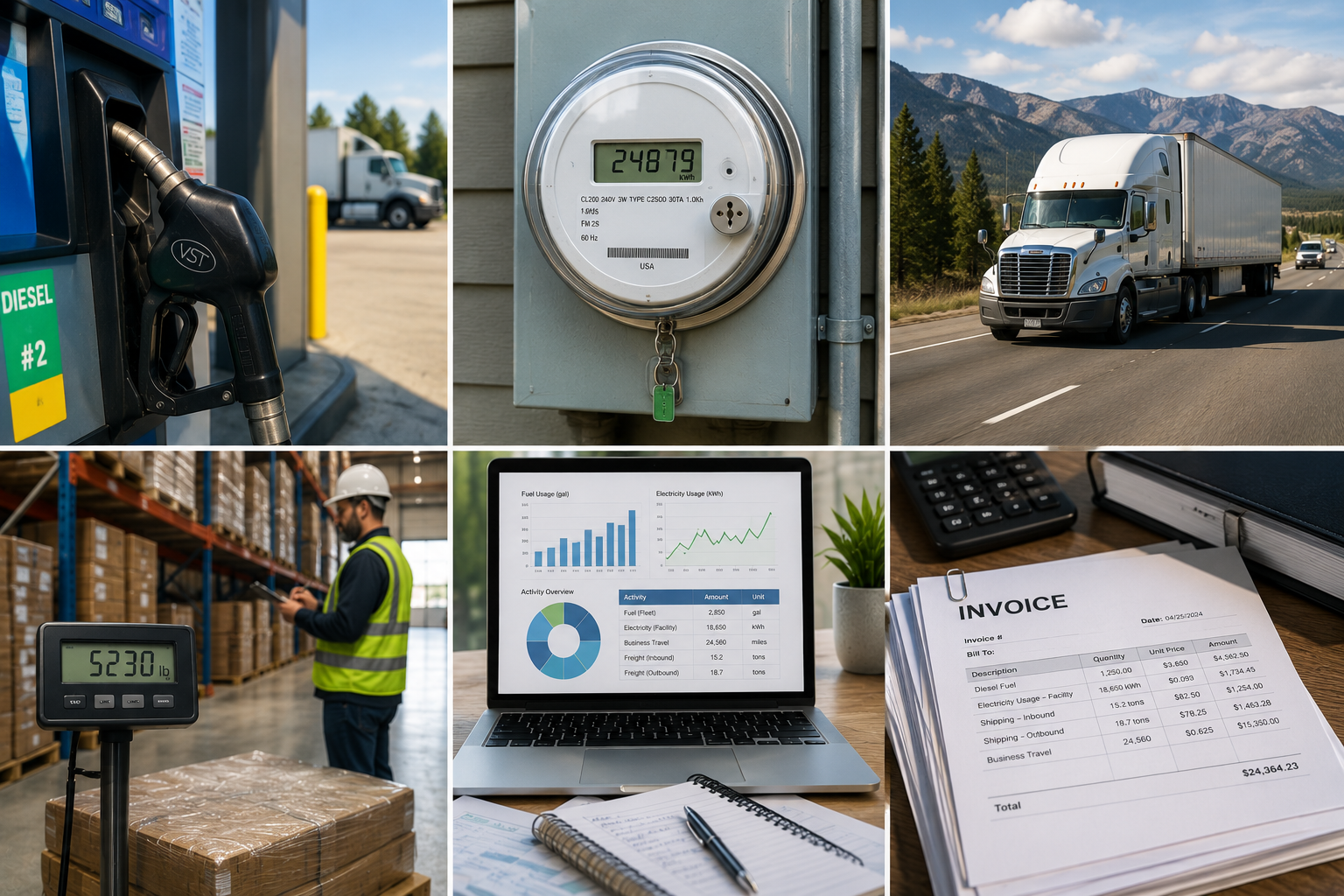
Activity data measures what actually happened — gallons burned, kilowatt-hours consumed, miles driven, tons shipped. Because it's tied to physical reality, it's the most accurate representation of your emissions, and it's sensitive to real operational change. Switch a delivery van to electric, and your activity-based Scope 1 number drops accordingly. Reduce a factory's energy use, and your Scope 2 figure reflects it directly.
The tradeoff is effort. Activity data requires detailed records — often at the level of individual invoices, meters, or supplier reports — and for anything outside your own operations, it depends on someone else being willing and able to share it. For Scope 1 and Scope 2, this data is usually accessible because it comes from your own utility and fuel accounts. For most of Scope 3, it frequently isn't available at all, at least not at the start.
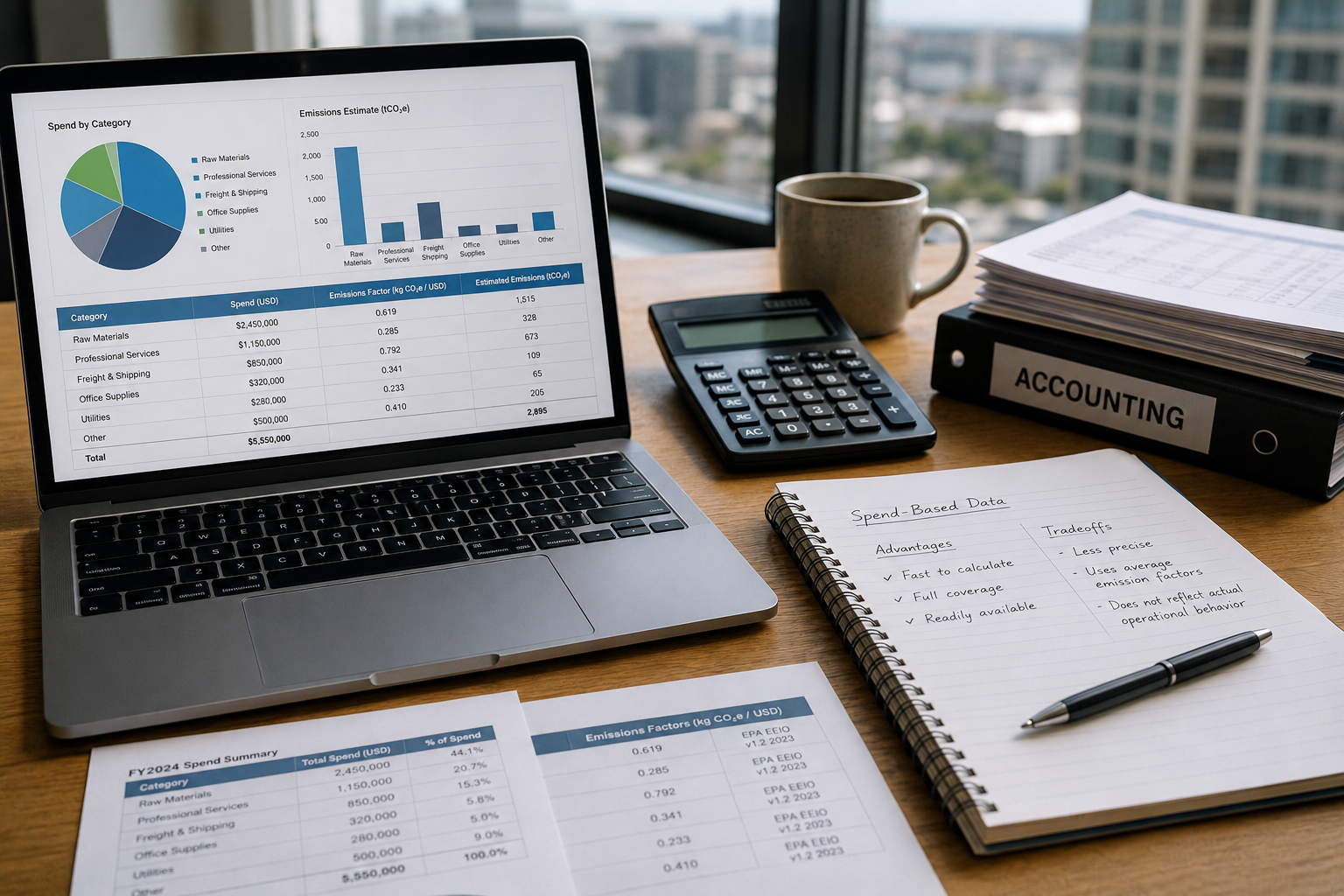
Spend-based data takes a different route: how much did you spend in a given category — office supplies, raw materials, professional services, freight — multiplied by a published emissions intensity factor for that category. Those factors typically come from environmentally extended input-output models, like the ones published by the EPA, which estimate the emissions associated with a dollar of economic activity in a given sector.
The advantage is speed and completeness. Every business already has spend data sitting in its accounting system, which means you can generate a full-coverage estimate — across every relevant category — almost immediately, without waiting on supplier disclosures that may never come. The tradeoff is precision. Spend-based figures don't reflect actual operational behavior; they reflect what a typical dollar in that category tends to produce. Two suppliers selling the same product at different prices will show different emissions under this method, even if their actual environmental impact is identical — and a company simply negotiating a lower price can see its reported emissions drop without changing anything about how the product was made.
The GHG Protocol doesn't ask you to pick one method and use it everywhere — it expects a blend, and it's explicit that data quality can improve over time. A useful hierarchy to keep in mind, from most to least precise: supplier-specific data, hybrid data (part activity, part estimate), average activity-based data using industry-standard factors, and spend-based data as the fallback.
In practice, that plays out predictably. Scope 1 and Scope 2 should almost always be activity-based — the data is close at hand, and there's little reason to estimate what you can measure directly from a utility bill or fuel receipt. Scope 3 is where spend-based data earns its keep: use it to establish full coverage across all relevant categories in your first year, then prioritize upgrading to activity-based or supplier-specific data for whichever one or two categories turn out to be your actual hotspots. You don't need — and shouldn't expect — activity-level precision everywhere at once.
Confirm your Scope 1 and 2 data is activity-based. If you're using fuel receipts and utility bills as the source, you're already there — no changes needed.
Decide which Scope 3 categories deserve activity-level effort this year. Based on the hotspot work from last chapter, pick one or two categories where more precise data would meaningfully change your picture.
Pull spend totals by category from your accounting system. This gives you a fallback for full Scope 3 coverage even before any supplier-specific data comes in.
Aclymate applies activity-based methodology automatically wherever the underlying data supports it — utility accounts, fuel records, and connected operational systems — and falls back to spend-based estimates using current EPA emission factors to fill any remaining Scope 3 gaps. As better data becomes available, the platform lets you upgrade individual categories without rebuilding your inventory from scratch. On the Aclymate One tier, your Carbon Bookkeeper helps you decide, category by category, where the return on more precise data is actually worth the effort.
Neither method is "wrong" — they answer different questions at different levels of precision, and a credible inventory usually uses both. Activity data where you can get it, spend data where you can't yet, and a clear plan for closing that gap over time. That combination is what turns an estimate into something you can stand behind.
With scopes and methodology now covered, the next natural step is putting it all together: building your first complete emissions inventory and setting your baseline year. That's where we'll pick up next chapter.
Get Aclymate's practical sustainability content delivered weekly.

Most sustainability mission statements fail before they're published. They're written to sound good rather than to mean something. Here's how to write one that actually guides decisions, holds up to scrutiny, and reflects what your business has genuinely committed to.
Read Article

Most businesses know they should be doing more on sustainability. Far fewer know where they actually stand. A sustainability maturity model gives you an honest picture of where you are, what's missing, and what the next stage looks like.
Read Article

If your company is considering SBTi validation, understand the people, data, cost, timeline, and ongoing obligations before you begin.
Read Article
Talk with a Sustainability Expert, see a demo, or start free to put the Aclymate platform and experts to work for your team.