← Back to Mike's Thoughts
Mike Smith
July 16, 2026

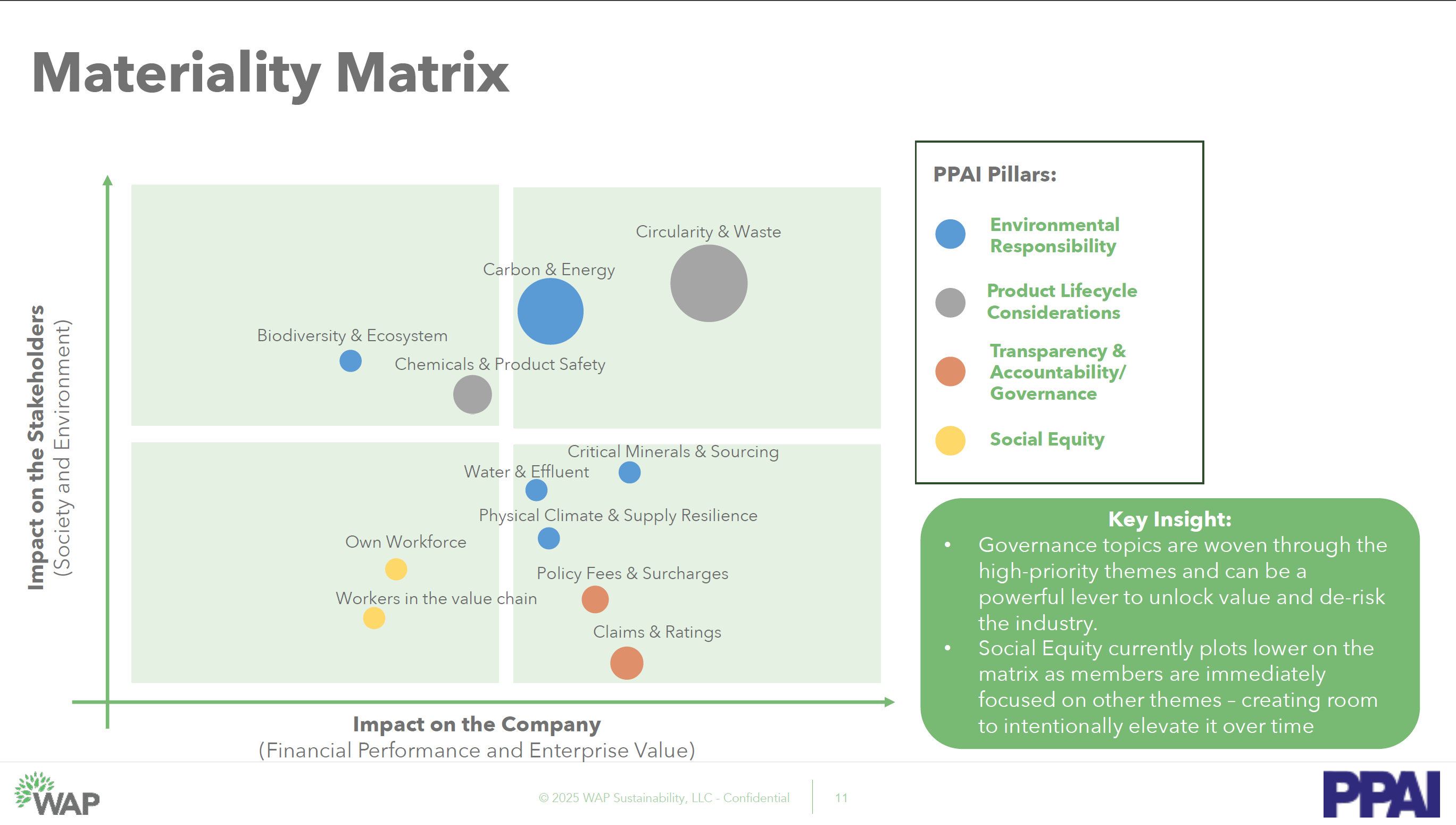
PPAI just released the results of a research project it commissioned with WAP Sustainability, a Double Materiality Assessment covering the whole promotional products value chain. If you're not familiar with double materiality, it's a framework that looks at two directions at once: how a company's operations affect people and the environment, and how sustainability issues affect the company's own financial performance. Regulators like the EU are starting to require this kind of assessment. PPAI decided to get ahead of it and build one for the entire industry.
I read through the whole thing, and it made me a little proud. This industry can feel scattered on sustainability, with lots of companies figuring it out on their own, but the list of members and industry associates who sat down for interviews to make this report happen is full of people I genuinely respect. Denise Taschereau in particular has been doing this work seriously for a long time, and it shows in how sharp this report is. Elizabeth Wimbush, if you're reading this, the same goes for you. Good research like this doesn't happen by accident. It happens because people who actually care about the industry show up and put in the time.
It's also a pretty clean confirmation of things I've been saying to Aclymate customers and prospects in this space for a while.
Of the 48 material issues PPAI identified, 19 fall under Environmental Responsibility and 15 fall under Product Lifecycle Considerations. That's 71% of everything, concentrated in two buckets. Governance, by comparison, showed up in only 2 of the 48.
That tracks. Promotional products live and die by what they're made of and how long they last. A tote bag or a water bottle either gets reused for years or it's landfill in a month, and that reality shows up everywhere in the data: carbon and energy, waste and circularity, water and effluent, chemicals and product safety. The report calls biodiversity and ecosystem impact the single highest-scoring issue, especially for members who depend on virgin materials from one source. That's a very specific, very fixable problem, and it's one I'd encourage any supplier reading this to take seriously.
Here's the part that I think is the most important finding in the whole report, and it's one that doesn't get said out loud enough in this industry. The costs and compliance burden of sustainability are not evenly distributed. Large upstream suppliers absorb most of the direct fees, the capital expense, the insurance exposure. But the actual work, the data requests, the documentation, the pricing pressure, cascades down to small and mid-size distributors through their contracts and their customers.
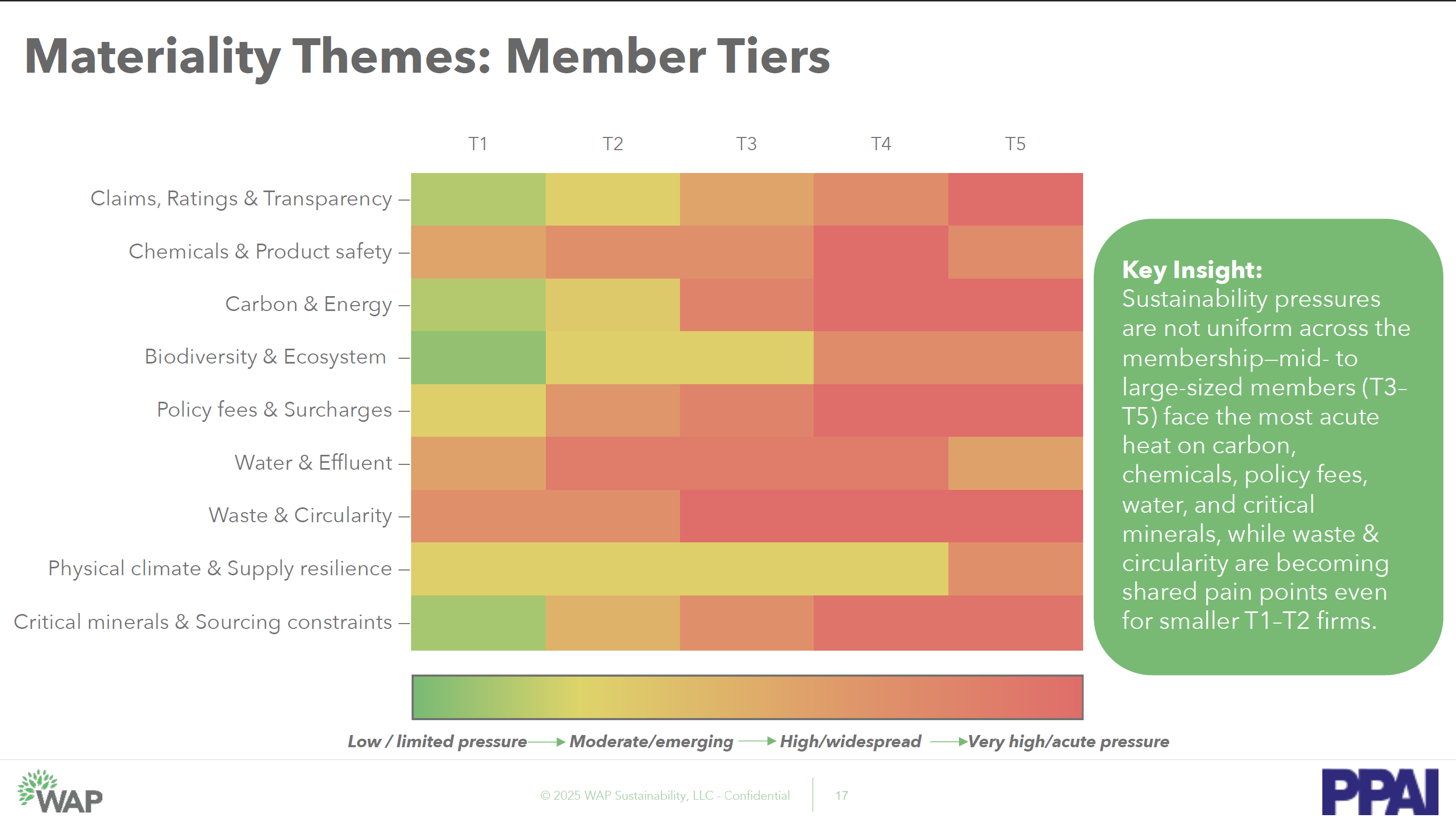
I've made this point to customers more times than I can count. A 15-person distributor doesn't have a sustainability department. They have someone wearing six hats who just got an email from a Fortune 500 buyer asking for Scope 3 data by Friday. PPAI's own tier analysis backs this up: mid to large members (their T3 through T5) feel the most acute pressure on carbon, chemicals, and sourcing, but waste and circularity pressure is now showing up even at the smallest tier. The squeeze isn't staying at the top. It's moving down.
What struck me most is where PPAI's roadmap actually lands. Two of their top opportunities are:
I don't say this to be self-serving, but that is almost word for word the problem Aclymate exists to solve. Credible, standardized, GHG Protocol-aligned data that doesn't require a distributor to become a sustainability expert overnight, and that suppliers can hand off in a format buyers actually trust. PPAI is describing, at an industry level, exactly the gap between DIY spreadsheets and expensive enterprise platforms that we built this company to close for the small and mid-sized businesses on both ends of that supply chain.
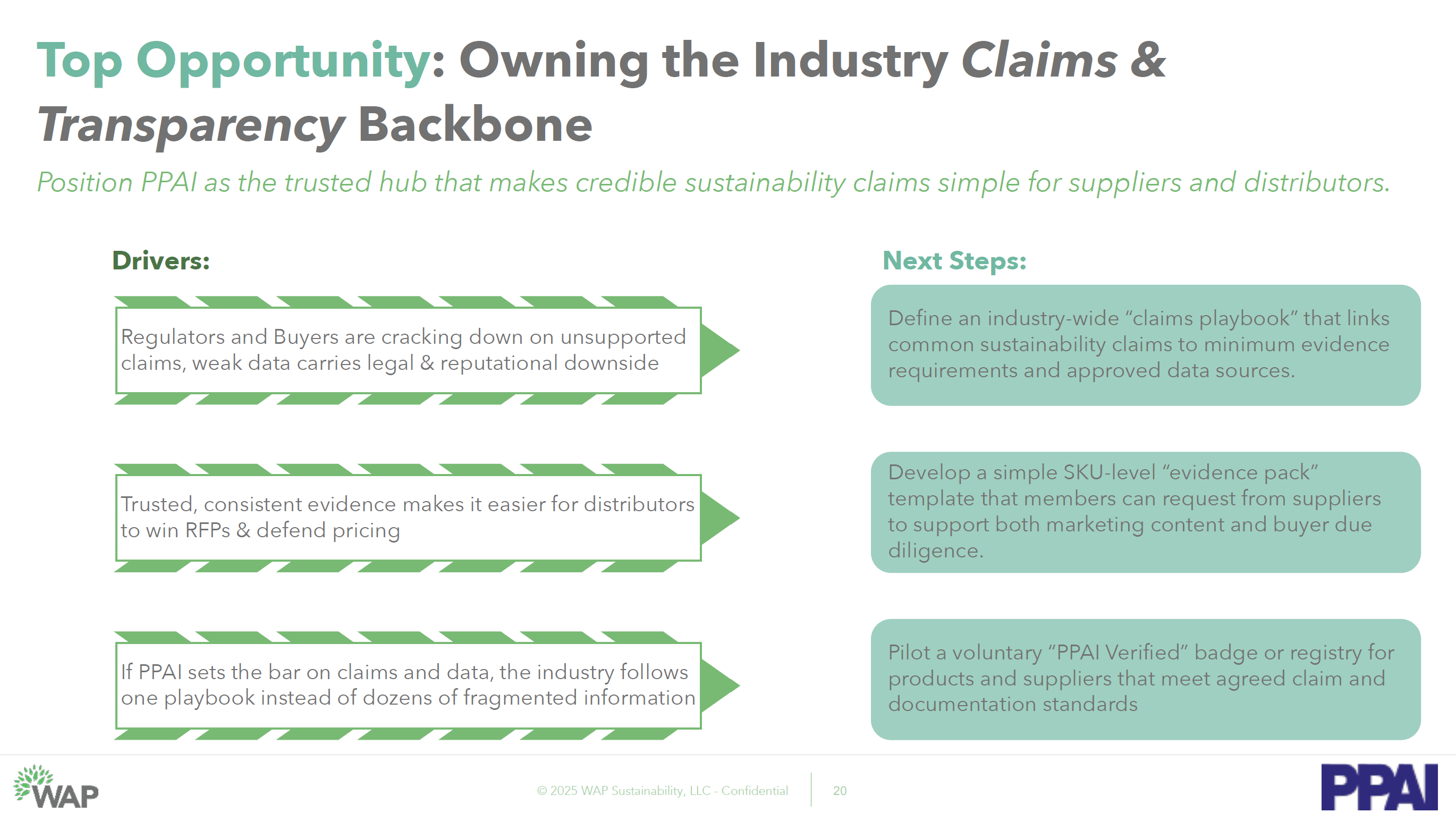
The report's claims and transparency backbone recommendation is right, but I want to add a layer under it, because I think it's the real reason the industry's claims problem exists in the first place.
I've written before about greenhushing, the practice of companies doing real sustainability work and then saying almost nothing about it publicly. Most of the conversation around greenhushing focuses on fear: fear of scrutiny, fear of getting the wording wrong, fear of a greenwashing accusation. All of that is real. But in promo specifically, I think there's a simpler, less talked about cause. A lot of the people making sustainability claims to buyers, the marketing and sales staff on the front line, don't have enough information to make the claim confidently in the first place. They're not staying quiet because they're scared. They're staying quiet, or worse, overstating, because nobody handed them the actual data.
That's a solvable problem, and it's a different problem than the one most claims playbooks try to fix. A claims playbook tells you what evidence you need. It doesn't put that evidence in front of the person on the sales call. Distributors carry the front line for claims, per PPAI's own report, while suppliers carry the evidence. Closing that gap means the evidence actually has to travel from one to the other, in a form a salesperson can use in real time, not just in a compliance binder somewhere.
PPAI's roadmap lays out a phased plan: toolkits and education this year, role- and product-specific training over the next two to three years, and by year five, sustainability metrics embedded into PPAI's own reporting standards with some kind of "verified sustainable product" designation. That's a real commitment, and it's the right shape for an industry this fragmented.
Here's my one real critique. The report is excellent at diagnosis. It tells you where the pressure is, who feels it, and why. What it doesn't spend much time on is the practical, near-term "here's what to do on Monday morning" layer. So let me add a few thoughts of my own.
First, none of this has to be solved alone or from scratch. There's a reason PPAI's own recommendation is shared infrastructure rather than every member building their own system. That's exactly the role we've tried to play at Aclymate for small and mid-sized suppliers and distributors in this industry, credible data, a real methodology, and a partner who already speaks GHG Protocol and ESRS so you don't have to become fluent in it overnight. If this report describes your Tuesday afternoon, we're an easy first call.
Second, get in the room with the people already doing this work well. This September, we're hosting Proof Over Promises, the Promo Climate Impact Forum, at Winter Park Resort here in Colorado. It's not a trade show. It's three days of working groups, real data, and honest conversation designed to move the industry from climate talk to credible action, together. I'm proud to be on the steering committee alongside leaders from PPAI, PromoShop, Storm Creek, 4imprint, and PCNA, including PPAI's own Elizabeth Wimbush, who I mentioned earlier. The name says it all: proof over promises. If you're going to make a sustainability claim, you should be able to back it up, and this is a place built for exactly that kind of accountability.
Third, and this is the one I think gets overlooked the most: the single biggest lever the industry has isn't a certification or a material substitution. It's whether the product actually gets used. PPAI's own report backs this up. Circularity and short product life show up as some of the highest-impact issues in the whole matrix, and the fix for a lot of that isn't a "greener" material, it's making sure the right product ends up with someone who actually wants it. Two concrete ways to do that:
None of this is complicated. It just isn't in the report, and I think it's worth saying out loud. PPAI has done the hard, foundational work here, and I have no doubt they'll keep leading on it. Aclymate, and I personally, are committed to being right there supporting that work, not standing on the sidelines.
If you're a supplier or distributor in the promo products space reading this and thinking "that's exactly my Tuesday afternoon," you're not alone, and you don't have to solve it with a spreadsheet and good intentions. That's a conversation I'm always happy to have.
Get Aclymate's practical sustainability content delivered weekly.

Your company may never be required to join SBTi. But if your customers have science-based targets, their commitments can create very real expectations for you.
Read Article

Most small and mid-sized businesses know they should be doing something about sustainability. The ones that actually make progress share one thing in common: they started with a clear sequence. Here it is.
Read Article
SBTi requirements are reshaping supply chains. Learn what science-based targets mean for carbon accounting, reporting, suppliers, and mid-sized companies.
Read Article
Talk with a Sustainability Expert, see a demo, or start free to put the Aclymate platform and experts to work for your team.